
DAO for Human Rights
This project involves the scoping, designing, building and ultimately testing of an online tool called a DAO (Decentralised Autonomous Organisation) for Amnesty International Aotearoa New Zealand and represents a great opportunity to establish innovative and influential partnerships, that can not only bolster Amnesty's reputation within New Zealand, but also reinforce it as a thought leader in the field of Human Rights Education (HRE).
Part of Technology Architecture
What began as a research question in early 2024 – can a global human rights movement coordinate participation, governance, and collective action through decentralised infrastructure? – has since evolved into one of the most comprehensive explorations of DAO governance undertaken within an international human rights organisation.
Over four funded milestones supported through the Cardano Project Catalyst ecosystem, Amnesty International Aotearoa New Zealand researched, designed, modelled, and prototyped a Human Rights DAO architecture intended to strengthen participation, accountability, and supporter engagement across distributed communities.
The project culminated in a governance framework, tokenomics model, open-source research outputs, and a functioning pilot application tested with Amnesty advocates across multiple jurisdictions. The final Closeout Report can be viewed here.
To our knowledge, this represents one of the most advanced explorations of decentralised governance infrastructure undertaken within the international human rights sector.
By sharing our expertise and knowledge in HRE, we aim to empower individuals to make informed decisions and take meaningful actions to uphold human rights. This, in turn, will elevate human rights advocacy, provide indicators for social impact in the human rights arena, strengthen the Amnesty movement, and broaden reach and diversity.
Our focus is on providing a central coordination mechanism for the crowd-sourced ideation and advocacy of the Amnesty 10 million person supporter base, exploring how contribution-based incentives, governance rights, and verifiable participation mechanisms might strengthen engagement within a global human rights movement. View the Amnesty project page here.
Working with our initial development team we designed DAO wireframes to meet the needs of the community and we provided a concept Lite Paper and deck to outline the project. The full research paper was completed August 2024 and can be viewed here, and has been published on SSRN here.
Github Link: https://github.com/Sugarlicks/AmnestyDAO-Token
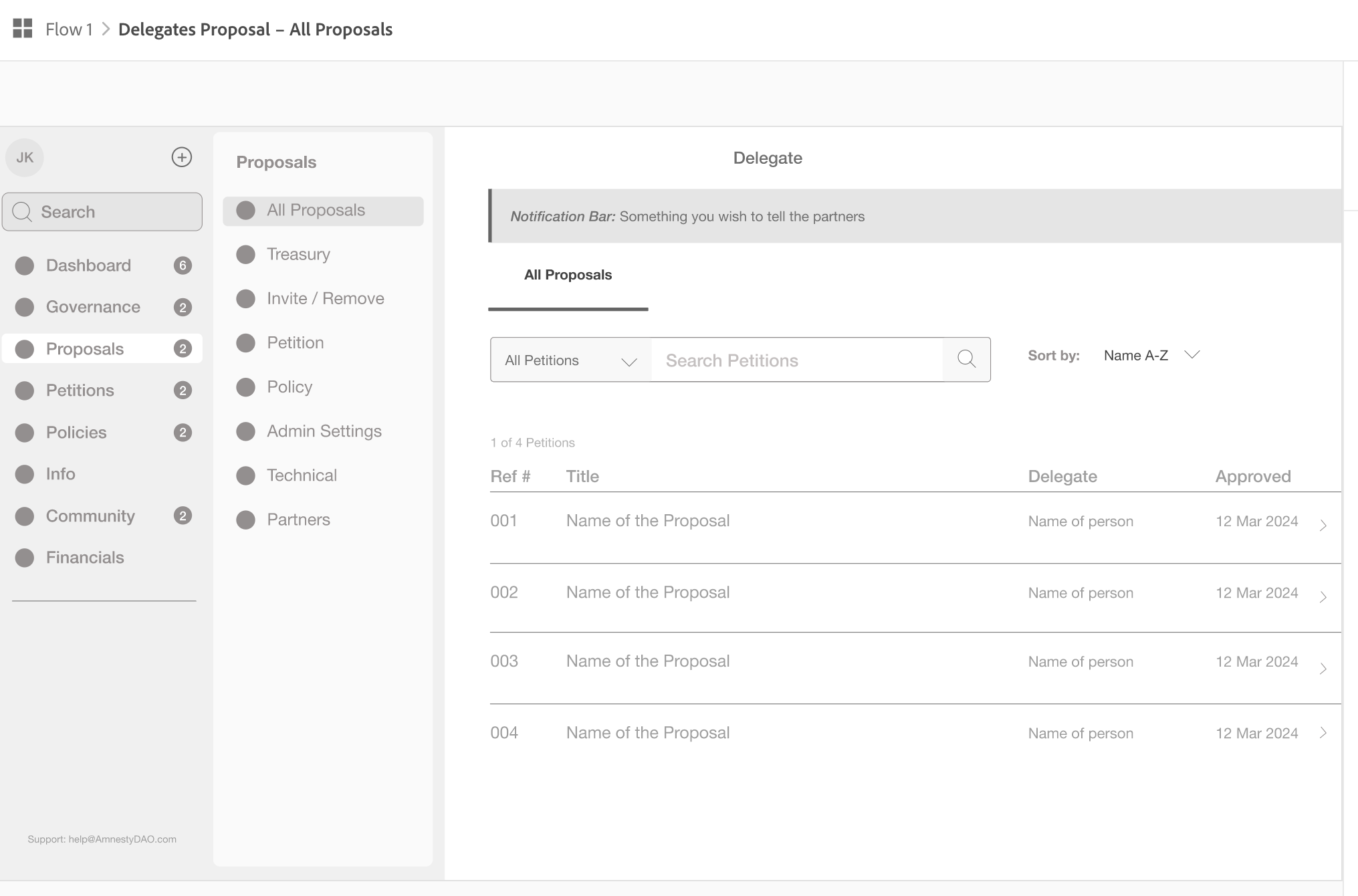
early wireframe screenshot
We received funding to develop the project on the Cardano Blockchain through the Project Catalyst funding ecosystem. You can view the full project here.
Research outputs
Research Paper (August 2024) — Member and Public Engagement in Amnesty International: Digital Democracy, Decentralised Governance, and the Case for a Human Rights DAO — SSRN · PDF
White Paper (July 2025) — DAO Governance Models for Social Impact and the Potential for a Human Rights Token for the Global Amnesty International Movement on the Cardano Blockchain — SSRN · PDF
Lite Paper and Deck — Concept Lite Paper · Discussion Deck
GitHub — github.com/Sugarlicks/AmnestyDAO-Token
Conference Presentations and Public Engagement
Research from the project has been presented through a number of international forums, including RightsCon (Taipei), Blockchain for Good Summit, Bread&Net UnConference, and the Reimagining Fundraising APAC Summit.
These engagements helped situate the work within broader conversations around digital public infrastructure, participatory governance, civic technology, and the future of human rights coordination.
The project can also be expressed as a problem-solution statement as follows:
The Problem Statement:
Amnesty International has 10 million supporters globally. Their participation in advocacy and governance is structurally limited: communication flows top-down, supporter energy is difficult to coordinate at scale, and the organisation's decision-making does not reflect the distributed intelligence of its membership. Viewed at full scale, a genuinely coordinated supporter base would give Amnesty the diplomatic weight and crowd-sourced resource of a nation. The question was whether decentralised technology could provide the infrastructure for that coordination — without sacrificing accountability, transparency, or human rights values in the process.
The Proposed Solution:
Amnesty International Aotearoa NZ aims to harness the transformative power of blockchain technology to create a decentralized autonomous organization (DAO). This DAO will serve as a digital town hall—a hub of knowledge, inclusivity, and transparency, dedicated to human rights education, advocacy, and policymaking.
Our vision for this innovative project is to:
Record the unforgettable: Implement an immutable ledger to capture and preserve every human rights micro-engagement, providing an invaluable historical record.
Amplify Voices: Create a platform where our supporters, the public and institutions can collaboratively shape the discourse on human rights, infusing it with diverse perspectives.
Empower decision-making: Utilise blockchain to enhance decision-making processes, ensuring inclusivity and facilitating governance.
Illuminate Transparency: Bolster transparency in our advocacy operations ensuring trust in the process
Encourage Participation: Drive widespread participation and encode incentive mechanisms, transforming passive supporters into active advocates for human rights.
What was built?
Working as Project Lead alongside Tech Lead Razali Samsudin and the development team at Matou.nz, the following was delivered:
A full DAO governance architecture – covering participation structures, decision-making layers, delegation models, and accountability mechanisms designed specifically for a human rights context where incentive design and values must be held together.
A Human Rights Token model – a value-backed token designed to incentivise micro-engagements and advocacy actions. Unlike speculative token models, this was designed from first principles around the question: what does meaningful participation in a human rights movement actually look like, and how do you encode that in an incentive structure without distorting it?
A pilot application – developed by Matou.nz, now in active testing with Amnesty advocates. Available on Android and Apple iOS.
Community consultations – conducted across Amnesty International chapters and allied civil society organisations in Q3 2025, shaping the governance design from within the movement rather than imposing it from outside.
Two published research outputs – a research paper (August 2024) and a comprehensive white paper (July 2025), both available on SSRN, establishing the theoretical and governance foundations of the model.
External funding validation – the project received funding through Cardano's Project Catalyst ecosystem, providing independent assessment of both technical feasibility and governance design quality.
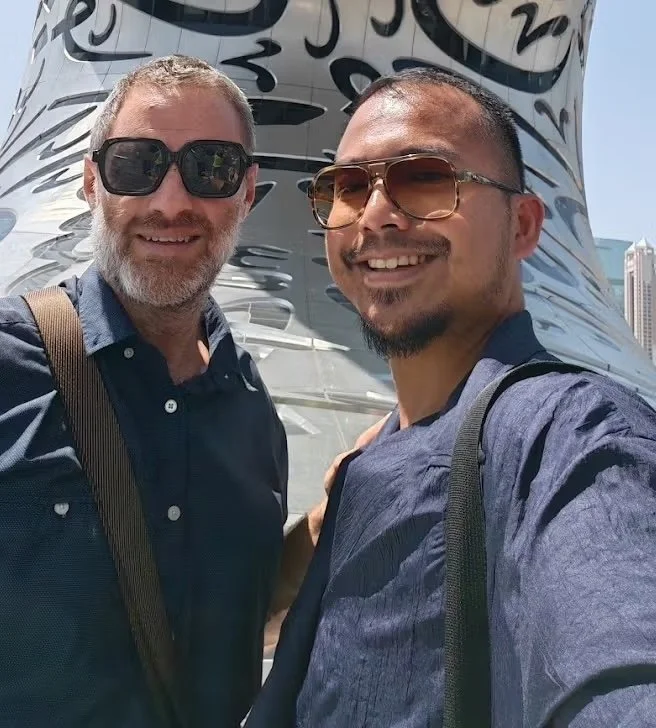
Gareth Farry & Razali Samsudin - HRDAO project leads
What was learnt?
One of the strongest findings from the project was that governance design cannot be separated from organisational culture. Technical systems can facilitate participation, but legitimacy ultimately emerges from trust, stewardship, transparency, and meaningful pathways for contribution.
The pilot also reinforced the importance of balancing openness with accountability. Human rights organisations operate within environments that require careful consideration of privacy, security, representation, and institutional responsibility. Governance infrastructure must therefore support participation without compromising these principles.
A further insight was that supporters often want more meaningful opportunities to contribute than conventional engagement systems currently provide. The challenge is not simply attracting participation, but creating structures capable of recognising, coordinating, and learning from it at scale.
Project Outcomes
The project delivered:
• A governance architecture designed specifically for human rights organisations.
• Tokenomics research exploring contribution-based participation and incentive mechanisms.
• A functioning pilot application tested with Amnesty advocates.
• Open-source documentation and governance resources.
• Community consultation across Amnesty chapters and civil society stakeholders.
• Published research outputs contributing to wider discussions on digital governance and civic participation.
• Independent funding support and validation through the Cardano Project Catalyst programme.
Please see the final project close out report here.
DAO walkthrough video
Replicability
The governance architecture developed here is not Amnesty-specific. The core design logic – layered participation, value-backed incentives, milestone accountability, and a clean separation between participation and stewardship authority – is replicable across any membership-based organisation that needs to coordinate distributed human agency at scale.
Organisations currently facing analogous coordination problems include international climate movements, indigenous rights networks, global development organisations, and civic bodies exploring participatory accountability mechanisms. If you are working on governance infrastructure in any of these contexts, the research, architecture, and deployment experience from this project are directly applicable.
Collaboration call to action
The pilot phase is now complete and the project is entering a new stage of organisational evaluation, adoption planning, and ecosystem engagement.
I am interested in conversations with:
Human rights and civil society organisations exploring decentralised governance as a coordination model for large, distributed membership bases — particularly those that have found conventional digital engagement tools insufficient for genuine participation.
Governance researchers and theorists working on participatory decision-making, token-based incentive design, or the intersection of blockchain governance and institutional accountability.
Funders and institutional partners interested in supporting the next phase of development, or in exploring how this architecture could be adapted for their own organisational contexts.
DAO builders and protocol designers who are working on governance infrastructure for social impact rather than financial speculation, and who want to engage with a project that has moved from theory to deployment.
The Amnesty project page is at amnesty.org.nz/dao. For collaboration enquiries: garethfakhry@gmail.com
The pilot successfully demonstrated the concept. The next stage is not about proving that decentralised governance can support human rights participation. It is about implementing that vision at the standard a global human rights movement deserves.